
October Diversity, Equity & Inclusion News
October 1 – UN: International Day of Older Persons
Recognizes the contributions and rights of older adults.
October 10 – World Inclusion Day
Informal observance encouraging people to practice inclusion in everyday interactions.
October 21 – LGBTQ+: International Pronouns Day
Promotes respecting, sharing, and using correct personal pronouns.
Polish American Heritage Month
The first Poles migrated to America starting in the early 1800s. This month, celebrate their contributions to culture and society. Once here, they were dedicated to preserving their heritage and culture and even started a national network of Polish-language newspapers, radio, and television stations to keep their language alive. New York State has the largest Polish-American population with Michigan, Wisconsin, and Connecticut having a substantial group too.
Italian American Heritage Month
Nearly 16 million Americans identify as Italian American according to the U.S. Census. Italian American Heritage Month occurs every October to overlap with Columbus Day, celebrated on the second Monday. It was first celebrated in 1989 with a proclamation from George H.W. Bush. Every year, a Columbus Day parade is held in New York City with an average million spectators.
Filipino American History Month
Filipino American History Month is celebrated as it was when the first Filipinos arrived in California in 1587. Many organizations in California and Hawaii, where many Filipino Americans reside, hold annual celebrations. Some call the month “Filipino American Heritage Month” while others regard it as a History month to focus on the events and lived experiences and their impact on society.
Attention Deficit Hyperactivity Disorder (ADHD) is a neurodevelopmental learning disorder that affects adults and children. It can lead to challenges dealing with self-control, focus, and impulsive behavior. This month hopes to raise awareness about the misconceptions associated with the community. Take time to promote understanding and support to all those living with neurodiversity all year.
This month is dedicated to increasing awareness of breast cancer, promoting screening and early detection, and raising funds for research into its cause, prevention, diagnosis, treatment, and cure. The campaign also offers support to those affected by breast cancer and commonly features pink ribbons as its symbol.
Each year, nearly 6,000 babies born in the United States are diagnosed with Down Syndrome, or 1 in every 700 babies. October focuses on the acceptance and inclusion of people with Down Syndrome. Learn about their unique strengths and promote a society and workplace that values diversity and offers support to those living with Down Syndrome and their families.
Global Diversity Awareness Month
This month is dedicated to celebrating and increasing awareness about the diverse cultures and populations that make up the world. It encourages individuals and organizations to learn about different cultures, as well as to promote inclusion and understanding across various cultural contexts. The celebration is an opportunity to reflect on the positive impact of diversity on society and to challenge and address issues of inclusion within communities and organizations.
National Disability Employment Awareness Month
This national campaign honors the contributions of people living with disabilities to the economy and workplace. It also raises awareness about disability employment problems and advocates for accommodations in the workplace for those living with a disability.
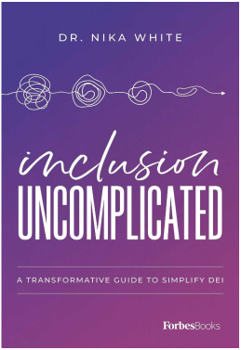
Diversity, Equity & Inclusion Book of the Month:
Inclusion Uncomplicated: A Transformative Guide To Simplify DEI
By Dr. Nika White, CDE®
This book is the guide you have been waiting for: one that unravels the complexity of diversity, equity, and inclusion, teases out root causes of systemic oppression, and delivers simple, actionable tools for real change. Right now. When it’s needed the most. The wisdom contained within these pages comes from Dr. Nika’s twenty-plus years of helping companies across the globe create more inclusive, equitable, and sustainable cultures. Dr. Nika’s philosophy is simple―DEI is a responsibility we all share. It’s going to take each one of us moving from passivity to impact within our unique spheres of influence.
That’s why this book is written in a straight-forward, conversational style that speaks to the leader in all of us. From real-life, workplace scenarios, to the latest research on what works and what doesn’t, to strategies for untangling the gnarled threads of bias―readers will find everything they need to become DEI allies, changemakers, and inclusive leaders, no matter where they are on the DEI journey.
Historical News:
October 3, 1965 – Immigration and Nationality Act
The 1965 Immigration and Nationality Act overhauled America’s immigration system, abolishing the discriminatory national origins quota system that favored European immigrants. Prioritizing family reunification, employment-based and refugee immigration, this act led to a significant increase in immigration from Asia, Africa and Latin America.
October 28, 2009 – The Matthew Shepard and James Byrd Jr. Hate Crimes Prevention Act
The Shepard-Byrd Act expanded the U.S. federal hate crime laws to include hate crimes motivated by a victim’s actual or perceived gender, sexual orientation, gender identity or disability. The act requires the FBI to track hate crimes based on gender and gender identity, allowing policymakers to better address gender-related hate crimes.
Local News:
The NAACP Culpeper Branch hosted its 45th annual Freedom Fund banquet on Saturday, October 3, which is themed “Standing Strong for a Seat at the Table.”
Nan Butler Roberts, former secretary of the branch and a longtime community leader and volunteer, was the 2026 honoree. Roberts has served as the president of the Scrabble School Preservation Foundation since 2016 and has held numerous board positions in the Piedmont region. A Rappahannock County native, she is a former “Citizen of the Year” in the county.
The keynote speaker was Dr. Tashika Griffith, who was named president of Germanna Community College earlier this year.
The NAACP will host their General meeting at the Library on Monday October 19th 5:45-7:45pm.
The will also host a Fall Community Book Club Discussion on Saturday October 24th 12:45-1:45pm.
On October 10, Culpeper County Library will host a Halloween Costume Closet from 10:30-2pm for community members to pick out costumes of all sizes at no charge.
ASL Chat at the Culpeper County Library on Tuesday October 6th & October 20th 6-7:45am.
Culpeper Literacy Council is excited to announce their new Director, Michelle Balderrama. She is a proud daughter of Bolivian immigrants and native of Culpeper, Virginia, Michelle is committed to expanding opportunity and bridging the divide between lived experience and institutional power. She is a Culpeper County High School Graduate and recent received her BA in Government & Neuroscience from Harvard University. At Harvard, she served as a Citizenship Tutor at the Institute of Politics, Social Media Director for Women in Business, and Spanish interpreter for the Harvard Law School Language Access Program.
They are continuing to offer English as a Second Language Programming, US Citizenship Test Preparation, English Conversation, Health Literacy and Spanish Classes.
The Free Clinic of Culpeper offers FREE Immigration Legal Services through Just Neighbors on the 2nd Monday of the month 1-3pm and the 4th Wednesday of the month 9am-12pm.
The Library of Congress Packard Campus announces public movie showings for October. Thursday October 15th will be a showing of “Drácula” (1931) – Filmed at night on the same sets as Universal’s English-language Dracula, this Spanish-Language Gothic horror film follows Count Dracula (Carlos Villarias) to England, where he preys upon Eva Seward (Lupita Tovar) and faces Vampire hunting Van Helsing (Eduardo Arozamena). Directed by George Melford. Black & White. Spanish with English Subtitles.
Culpeper County Public Schools was proud to recognize two individuals whose commitment to inclusion, compassion, and service has made a meaningful impact on students and school communities. The 2025-2026 CCPS Inclusive Spirit Awards have been presented to Jacqueline Nordenger, a teacher at Eastern View High School, and Lilliana Barnhill, a student at Pearl Sample Elementary School.
The Inclusive Spirit Award recognizes individuals who exemplify CCPS’ commitment to creating welcoming, supportive, and inclusive learning environments where every student is valued and empowered to succeed. CCPS Honors Staff Member and Student with 2025-2026 Inclusive Spirit Awards | Pearl Sample Elementary School
His Village Church will be hosting their Ubuntu & Humanidad Heritage Festival in downtown Culpeper on 111 South Commerce Street on Saturday October 10th 1pm. The event will feature Live Music, food, family activities, vendors and cultural exhibits.
Museum of Culpeper History dedicated M
State News:
The Charlottesville Regional Chamber’s Minority Business Alliance (MBA) will host its annual gala on Friday, October 9, 2026, from 6 to 10 p.m. at The Brick Cellar, located in the basement of Dairy Market. This year’s theme, “The Golden Hour,” honors the leaders, entrepreneurs and community champions who illuminate Charlottesville’s minority-owned business community and help create opportunities for others to thrive.
The Virginia Hispanic Chamber encourages you to invite Latino restaurants in your community to participate for free in our Restaurante Week, scheduled for October 5 to 11.
Monday Robinson: A Life of Thorns and Roses Exhibit
Belle Grove Plantation
336 Belle Grove Road, Middletown, Virginia
Join us for a new exhibit that explores the freedom, resilience, and survival in early America through the life of one extraordinary man. The exhibit will continue to be on view at Belle Grove from Saturday, September 26, 2-4 p.m. through Wednesday, October 14 before traveling to other museums and libraries in Virginia.
From slave to enslaver: The life of Monday Robinson
By Brian Brehm, July 30, 2026 Winchester Star
Belle Grove Plantation in southern Frederick County is preparing a new exhibit detailing the life of Monday Robinson, a former slave who became a slave owner.
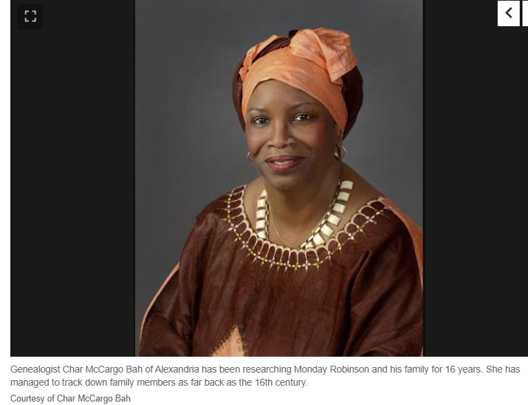
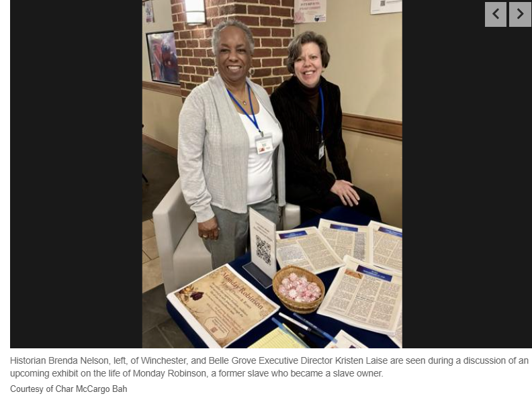
Robinson, who spent the final years of his life in Middletown, was the subject of a Shenandoah University forum on March 20 that featured Belle Grove Executive Director Kristen Laise, Winchester historian Brenda Nelson and Alexandria-based genealogist and journalist Char McCargo Bah. Afterward, Laise announced that Belle Grove would create an exhibit called “Monday Robinson: A Life of Thorn and Roses,” which is scheduled to open on Sept. 26 at Belle Grove, located south of Middletown.
Laise, Bah and Nelson, along with Robinson descendant Frances Norton Burton and exhibit designer Jess Pritchard-Ritter, recently met in a video conference to discuss the upcoming exhibit and Robinson’s life.
A cemetery lost and found
Research into Robinson originated in Alexandria, a city in Northern Virginia that was occupied by Union soldiers during the Civil War. Slaves who ran away from their enslavers in the South frequently ended up in Alexandria, Burton said, “because once they got behind Union lines, they were free.”
But that was perhaps the only positive thing. At the start of the Civil War in 1861, Burton said many of the former slaves lived in encampments and were exposed to diseases including smallpox. Those who died were buried in a new cemetery created and operated by the Union Army.
After the Civil War ended in 1865, the slave cemetery was seldom used. The last recorded burial there was in January 1869, just a few months after the federal Freedman’s Bureau, which helped former slaves transition to freedom, scaled back its services. As a result, the cemetery and its more than 1,700 graves were abandoned and eventually forgotten.
“In modern times, it looked like just a piece of land,” Burton said.
In the 1990s, a $2.4 billion project to replace the nearby Woodrow Wilson Bridge from Alexandria to Prince George’s County, Maryland, got underway. During excavations for the project, Burton said workers in Alexandria began digging up pieces of metal. When the metal pieces became numerous, archaeologists were called in and determined that workers were digging up coffin hinges from an old cemetery.
Recognizing the property’s importance, the city of Alexandria purchased the land to create a memorial park. The newly designated Contrabands and Freedmen Cemetery was preserved and dedicated in 2014. It includes artist Mario Chiodo’s sculpture “The Path of Thorns and Roses,” which is representative of the former slaves’ struggle for freedom.
Using a record of burials that was maintained in the 1860s by the Rev. Albert Gladwin, cemetery officials wanted to see if any descendants of the former slaves could be located. They asked Bah to use her genealogy skills to find anyone she could, and her investigation eventually led her to Burton’s door in Alexandria.
“One of the first people that she found [in the burial records] was the child of my great-great-aunt, who was Lucy Robinson,” Burton said about Bah. “Lucy Robinson came to Alexandria after she was freed through the [last ]will [and testament] of Monday Robinson.”
Lucy was one of Monday’s estimated 12 children.
Born into slavery
 Monday Robinson was born in 1778 in Westmoreland County as a slave owned by a man with property holdings throughout Virginia. When the owner died, Monday was willed to the owner’s wife. When she died, he was inherited by one of the owner’s children. When he died, Monday became the property of one of the owner’s grandchildren.
During his enslavement, Monday married a fellow slave named Polly who was about 20 years younger than him. The exact date of their wedding is unknown because in the early 1800s, marriage documents for slaves were frequently not recorded.
Since Polly was a slave when all 12 of their children were born, the sons and daughters were slaves as well.
“Children [who were Black] got their lineage from their mother,” Burton said. “She (Polly) was a slave, therefore all of her children were slaves.”
In 1813, Monday was granted his freedom in Loudoun County.
“The law during that time stated that if you were a free person, you basically had to leave the county because they didn’t want you to give the enslaved any ideas,” said Bah, who has spent 16 years researching Monday and his family.
Bah said Monday was exempt from the leave-the-county rule because he held the deed for Polly and three of their children, making him a slave owner. He later moved to Shenandoah County before settling in Middletown in Frederick County.
Being a skilled shoemaker, Monday earned a decent living. Records show that he and his family owned horses and real estate, and he paid taxes just like every other entrepreneur.
When Monday died in late 1856 or early 1857 — the exact date is unknown — his will did not contain provisions to free his family. It fell upon his brother, Henry, to settle Monday’s estate and file a deed of manumission in Frederick County that released Polly and her offspring from slavery.
(Manumission is a word for the voluntary freeing of slaves by their owners via verbal consent, written documents or wills.)
When the family was lifted out of slavery, the leave-the-county rule kicked in. Bah said the Robinson children ended up in various places including Alexandria, Washington, D.C., and Pittsburgh, Pennsylvania.
As for Monday, no one knows where he is buried. It’s assumed he was laid to rest somewhere in or near Middletown, but there was no record of his burial.
Why?
 So why did Monday keep his wife and children enslaved?
Bah said there could have been several reasons for this, such as a desire to keep the family together or protect them from the harsh realities of freedom for Black people in the racially troubled 19th century.
On the other hand, Bah learned that Monday profited from his enslaved children by occasionally hiring them out to other property owners. Also, in 1824, he used his wife and three of their children — Elliott, Louisa and William — as collateral to obtain a $490 loan from a man named William L. Clark.
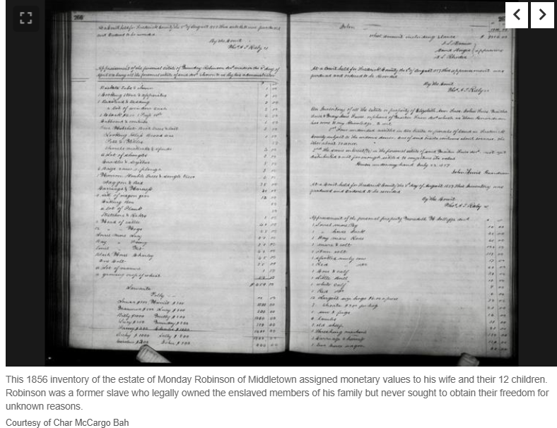
Bah said Monday could not read or sign any documents presented to him, so he may not have been fully aware of what the paperwork said. Burton added that it’s possible he wasn’t aware that an 1856 inventory of his estate assigned a monetary value to each of his family members. The children were worth anywhere from $100 to $1,000, while Polly’s value was listed as $0.
Those values became moot once Monday’s brother, Henry, became executor of Monday’s estate and secured the freedom of Polly and her children.
Whatever his reason for keeping his family enslaved, Burton was devastated to learn that one of her ancestors was a slave owner.
“I wanted to be done with it,” Burton said. “It broke my heart.”
In the ensuing years, though, as she learned more about Monday and the possible explanations behind his rationale, Burton eventually came to terms with the situation.
Telling Monday’s story
In May 2025, Bah contacted Laise to tell her about Monday Robinson.
Laise said she had actually heard about Monday and his connection to Middletown and Belle Grove a few years earlier, when she spoke with Burton as part of Belle Grove’s research into the slaves who worked at the plantation. Approximately 270 people were enslaved there by the Hite family from 1738 to 1851. They have been honored in two recently completed memorial quilts on permanent exhibit at Belle Grove.
“We realized that Monday Robinson had come onto the Belle Grove property as a free Black man and purchased some things when Ann Hite, the second wife [of Maj. Isaac Hite Jr.] at Belle Grove, passed away in 1851,” Laise said. “They had an estate sale.”
Among the items Monday bought, Laise said, were shoemaking tools.
Laise entered into a collaboration with Bah, Burton, Nelson and Pritchard-Ritter to come up with ideas to share the story of how a former slave became a slave owner himself.
“We thought it would be a great example of how we can work with descendant communities, so we put our heads together to do this research and have a traveling exhibit,” Laise said.
The exhibit will open at 10 a.m. Sept. 26 at Belle Grove in a ceremony that will include Burton and other descendants of Monday. Afterward, it will travel to museums and libraries in 14 Virginia localities, including Winchester, that have ties to Monday and his family.
 “The hope is that by getting some of the research out there, maybe other information, other stories and data points might come up,” Laise said.
Monday’s story, Laise said, will be representative of the complicated Black experience in America.
Assembling the exhibit on Monday and his family will be Pritchard-Ritter, who said she wants to include not only the research, but also “the passion and the feeling” that Burton, Bah and Nelson experienced as they learned about Monday’s conflicted life.
“It’s complicated. There are a lot of twists and turns,” Pritchard-Ritter said. “I’m trying to capture their research and evoke emotion but not tip our hand to make people feel one way or another.”
No one will ever know why Monday kept his family enslaved, but Pritchard-Ritter said the exhibit will show how other events happening in Virginia during the 19th century — including Nat Turner’s Rebellion in 1831, which was a three-day slave revolt in Southampton County that left nearly 200 Blacks and whites dead — may have influenced his decisions and actions.
“We all have our thoughts [about Monday],” Burton said before sharing her personal theory. “I believe that part of his thinking was subterfuge (i.e. deceit used to obtain a goal) as a way to keep his family together. … I think that he was playing a game.”
To learn more about the upcoming Monday Robinson exhibit and Belle Grove’s ongoing research into the Middletown plantation’s slaves and their descendants, visit bellegrove.org.
— Contact Brian Brehm at bbrehm@winchesterstar.com
National News:
With time running out to process thousands of applications, a federal judge directed the Trump administration to extend a deadline by 10 days following claims that officials deliberately stalled a visa program.
In his Wednesday ruling, U.S. District Court Judge Edward Davila, based in Northern California, concluded, “Considering this series of events, the Court finds the most measured and tailored remedy … is to require that DOS (Department of State) continue adjudicating Diversity Visas” for 10 additional days. It is the same period of time that DOS “failed to instruct all diplomatic and consular posts to comply with the Court’s order.”
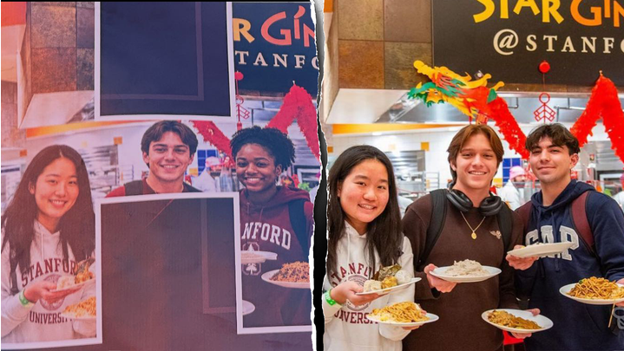
Stanford confirmed that Residential and Dining Enterprises (R&DE) used generative AI to modify the appearance of several students in a promotional image. R&DE changed the students’ clothing into Stanford merchandise, slimmed down two students’ faces and entirely changed one student’s race, gender and appearance.
Students outraged after Stanford University uses AI to alter race in photo
Timothy Pigford, the North Carolina farmer whose name became synonymous with one of the most consequential civil rights cases in American agriculture, died Aug. 23 in Washington, North Carolina. He was 74.
Pigford was the lead plaintiff in Pigford v. Glickman, the 1997 class-action lawsuit brought by Black farmers who alleged the U.S. Department of Agriculture discriminated against them in farm lending and failed to properly investigate their complaints. The case ultimately resulted in what has been described as the largest civil rights settlement in U.S. history.
Iconic Black Farmer Advocate Timothy Pigford Dies at 74
Converse has discontinued an advertisement following public backlash last week over what critics said appeared to be Ku Klux Klan symbolism and lynching in the shoe and apparel company’s ad campaign.
Converse removes ad, apologizes following backlash over alleged KKK imagery
The National Bureau of Economic Research published working paper on the Racial Dynamics of Federal Property Buyouts in Flood-Prone Areas. This paper investigates the role of race and ethnicity in buyout bargaining outcomes and how those outcomes affect longer-run neighborhood change. We combine nationwide administrative data on federal property acquisitions, housing sales transactions, and restricted-use Census microdata to estimate whether there are systematic differences by race in buyout payments relative to a property’s fair market value. We then use a database tracking individual movement over time to examine the quality of the neighborhoods to which participants move and how neighborhood outcomes vary by race and program participation. We find that the buyout compensation received by households of color is at least 6 percent lower than that received by white households. White participants relocate to higher quality neighborhoods and are better off than white nonparticipants. Black participants, on the other hand, move to worse neighborhoods and are worse off than Black non-participants. Our work highlights how government policy, aimed to address increasing climate impacts, may exacerbate the burden of climate change on vulnerable communities.
Racial Dynamics of Federal Property Buyouts in Flood-Prone Areas | NBER
Miss North Carolina USA Brittany Boltinhouse stripped of title after alleged racist posts resurface
On September 16, at the lead-up to the 81st UN General Assembly, Equality in Family Law (GCEFL), Equality Now, TrustLaw, and the World Bank Group convened in New York City for the event titled The Gender Equality Dividend: Investing in Women’s Economic Prosperity Through Family Law Reform. Hosted by APCO, the event introduced new data on barriers to family law reform and highlighted strategies to help the international community maximize women’s economic participation.
Family Law Reforms Are Needed to Advance Gender Equality | Inter Press Service
ROCHESTER, NY- September 24, 2026 – S. Mona Sinha, Chief Executive Officer of international nonprofit organization Equality Now, was inducted this evening into the National Women’s Hall of Fame at the George Eastman Museum in Rochester, New York.
Mona Sinha, CEO of Equality Now, inducted into National Women’s Hall of Fame – Equality Now